Showing posts with label Long Beach Coin Auction. Show all posts

Monday, August 10, 2009

One of 20: A Proof Gold Story

Aug. 10, 2009
Posted by John Dale

“This issue has a mintage of only 20 pieces.”

That’s a sentence that can get a collector’s heart racing. Just 20 pieces… the number is so tiny, especially compared to the millions upon millions of coins struck every year, that it’s almost unfathomable how so few examples could be made. Yet in the context of the U.S. proof gold coinage of the 19th century, mintages in the double digits are the norm. Rarity itself is commonplace.

When years can pass between appearances of a single issue at auction, it takes a near-heroic level of dedication (not to mention a hefty bank account) to assemble a complete set of any proof gold series. Thus, while the prices for coins such as proof Liberty double eagles may be in the tens of thousands of dollars, those prices would be much higher if the series enjoyed greater popularity.

Among the proof Liberty double eagles struck in 1859 and after, four dates—the 1874, 1875, 1877, and 1878—tied for the lowest mintage, at just 20 specimens each. In its September 2009 Long Beach U.S. Coin Auction, Heritage will offer an example of the proof 1877 double eagle, graded PR58 Cameo by NGC.

Being one of just 20 pieces struck (and one of just 10 to 12 of them to survive, according to recent estimates by Jeff Garrett and Ron Guth) is itself an impressive story, but there’s more to this proof coin than just a low mintage. The key lies in its grade: PR58 Cameo. Proof coins are meant for display, not commerce. In theory, they should not acquire wear. Yet this proof’s grade of PR58 Cameo falls outside the 60-to-70 numeric range that indicates a coin is not worn. What happened to it?

Close examination shows a number of contact marks, as well as some disturbance of the mirror finish in the fields. It’s possible that this was simply a proof that was mishandled by a previous owner. There is another, more resonant possibility: the coin might have been spent. The $20 face value of this proof in 1877 would be equivalent to several hundred dollars in today’s money, and it’s easy to imagine a family desperate for funds spending some of those proofs, particularly the ones with the highest face values.

It was a scene that played out many times, especially during financial panics such as the one in 1893. Proof coins of virtually all dates are known with a degree of wear. Yet almost inevitably, such coins left circulation almost as soon as they entered; while those experiencing hard times spent the proofs, others saved them for themselves, ultimately saving those proofs for today’s numismatic community.

Of course, not every proof gold collector is interested in impaired proofs. In that case, we have a very nice Superb Gem Ultra Cameo proof 1891 double eagle to sell you…

To leave a comment click on the title of this post.

-John Dale Beety

Friday, May 22, 2009

Coin Friday and Monday: That coin

May 22, 2009
Posted by John Dale

(Because Monday is a holiday, and most of us are going to be remembering our fallen soldiers and celebrating the start of summer, John Dale and I huddled and decided to move Coin Monday to today and let the Coin Monday faithful have a full long weekend to savor the work. That, and I am always happy to turn an extra day over to John Dale; I learn as much from his posts about coins as in any part of my job, and more than once I’ve related facts that I’ve picked up in these posts to friends and family. No kidding. The most useful is to never – ever! – call a cent a penny. I repeat, NEVER call a cent a penny. You don’t want to see what happens to a numismatist when you commit this egregious sin. My thanks to John Dale, and my wishes to you for a safe and happy Memorial Day weekend. – Noah Fleisher)

The idea of a condition census, or listing of best examples, for a date or die variety is time-honored in numismatics. Usually, the condition census will show a sliding scale of grades, such as the top two or three coins being graded AU55, the next best examples XF45 or AU50, and so on, with small rather than large differences in quality from one piece to the next. A few issues, however, have coins in their condition censuses that have become famous in their own right; the Abbey Cent, a 1799-dated large cent, is not at the top of any generally accepted condition census for its variety, yet it has achieved such fame that merely saying “Abbey Cent” sparks instant recognition among many early copper collectors.

In other instances, a coin is without rival, far ahead of the other pieces in the condition census, and gains recognition for its quality; such a coin may be referenced by grade or by pedigree, if the latter is applicable, and the highest possible honor is to be known simply as “that coin,” as in the following conversation:

Cataloger A: “So, have you seen anything exciting today?”

Cataloger B: “We’re getting in an 1856-O $20.”

Cataloger A: “Oh, nice! What grade?”

Cataloger B (smiling): “It’s a 63.”

Cataloger A: “A 63! …oh, is it that coin?”

Cataloger B (nodding): “Yes, it’s that coin.”

Our Long Beach Auction press release covers plenty of ground on the Specimen 63 1856-O double eagle, but it’s hard to convey in a press release how it feels to be in the presence of a mind-blowing coin, one that takes the expectations a collector has for an issue and turns them upside-down; it is not lackluster but gleaming, not softly struck but sharp, not heavily abraded but lightly marked. Until its reintroduction to the numismatic community, no collector even dreamed that an 1856-O $20 like it could exist, and once it appeared on the market, its impact was immediate. Phrases such as “the single most important New Orleans double eagle in existence” are not mere puffery, but reflections on the esteem in which this specimen is held. A common refrain among numismatists is, “If only this coin could talk!”

Perhaps it’s just the auction-house employee in me, but I imagine that if coins could talk, this one would be singing like Eartha Kitt and wanting an old-fashioned millionaire.

Click on the title of this post to leave a comment.

-John Dale Beety

Monday, May 18, 2009

Coin Monday: A San Francisco Double Feature in Long Beach

May 18, 2009
Posted by John Dale

The United States Mint experienced dramatic changes in the 1860s, with three of five Mints (Charlotte, North Carolina; Dahlonega, Georgia; and New Orleans, Louisiana) leaving the fold after the states they were in seceded. Only the main Mint in Philadelphia and the branch in San Francisco remained open, and Philadelphia produced all coinage dies, sending dies to San Francisco as needed. With wide swaths of the American West still unsettled, communication between Philadelphia and San Francisco lagged, and two distinctive S-mint $20 gold coins (or double eagles) resulted from that lag, both of which make an appearance at our upcoming Long Beach Auction.

The first issue had its origin in a short-lived design change for the double eagle denomination. In the waning months of 1860, Anthony C. Paquet, an assistant Mint engraver known more for his medals than his coinage-work, prepared a modified reverse die for the double eagle distinguished by tall, thin lettering that was one of the engraver’s signatures. The design received approval, and Paquet reverse dies were sent to New Orleans and San Francisco for use with obverses dated 1861. Philadelphia discovered an apparent problem with the rims of the Paquet design, spurring the then-Mint Director, James Ross Snowden, to halt use of the Paquet reverse and send the same orders to New Orleans and San Francisco.

While Snowden’s early January telegraph reached New Orleans promptly, there was not an extensive telegraph network west of the Mississippi river, and the Mint Director’s message had to be carried overland from Missouri to California. By the time Snowden’s instructions arrived at San Francisco, 19,250 double eagles had already been struck with the Paquet dies and released into circulation. While most of the 1861-S Paquet double eagles are now lost, around 200 survivors, including this AU53 example, remain. Collectors who view the Paquet double eagle as a distinct subtype (myself included) have made it one of the most in-demand San Francisco double eagles.

Similarly, the time and distance between the East Coast and West Coast Mints created another prized variety, the 1866-S No Motto double eagle. In 1866, the various larger-size coinage designs were modified to incorporate the motto “In God We Trust,” an inclusion said to reflect a nation that had increasingly turned to prayer for comfort during the trials of the Civil War. As was customary, Philadelphia shipped the next year’s obverse coinage dies to San Francisco in advance, and the 1866-dated obverse dies arrived at the California facility in November 1865, but no new reverse dies were included. Though Philadelphia refrained from coinage until the various With Motto dies were ready, San Francisco went forward with production using old reverses, and several 1866-dated San Francisco issues are split between No Motto and With Motto pieces, including the half dollar, $5, $10 and $20 denominations.

Communication between Philadelphia and San Francisco improved and in 1877, when the Mint made the next significant change to the double eagle design, there was no laggard San Francisco issue. Still, double eagles such as the 1861-S Paquet and the 1866-S No Motto survive as reminders that even after the most dangerous Gold Rush days were done, there was considerable separation between the Western states (first California, later Oregon and Nevada) and the rest of the states in the Union, a distance measurable in both weeks and hundreds of miles that the Mint and many others had to overcome.

Click on the title of this post to leave a comment.

-John Dale Beety

Thursday, May 14, 2009

Coin Thursday: Kosoff and a King’s Collection

May 14, 2009
Posted by John Dale

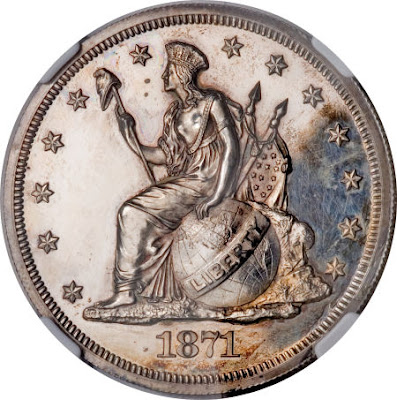
The May Long Beach auction has a pair of unexpected treats in the form of two old-time collections that have been off-the-market for half a century or more. The more prominent of these two collections is the Frank M. Stirling Collection, which contains a number of gorgeous patterns and other coins that come with envelopes from leading dealers of the 1950s. Names such as Hans M.F. Schulman, M.H. Bolender, and B. Max Mehl are all represented. Most interesting is the card accompanying lot 1428,an extremely rare Judd-1138A Indian Princess dollar struck in silver. The card notes that the pattern was previously in the Palace Collections and notes its sale to “F.M. Stirling,” with the signed attestation of Abe Kosoff.

Abe Kosoff was a titan among numismatists of his generation, not only one of the most knowledgeable and prominent dealers of the era but also held in high regard as a gentleman and friend; Q. David Bowers subtitled his biography of Kosoff “Dean of Numismatics,” a title with just the right connotation by virtually all accounts. He died in 1983, before I was born, so I never had the opportunity to meet him, but he left a remarkable body of written work in the form of a series of articles. These articles, published over a 13-year span in Coin World, were collected in the volume Abe Kosoff Remembers… and organized by topic.

One topic, which dominated Kosoff’s column for three months in late 1977 and the start of 1978, is the auction of the Palace Collections of Egypt in 1954. These collections, assembled by King Farouk of Egypt at great cost to the national coffers and confiscated after Farouk was driven out of the country by a military revolt, included coins, stamps, artworks, and antiquities. The coin auction was cataloged by Baldwin of London on-site in Cairo, and the polyglot auctioneer who called the lots was from Sotheby’s. Kosoff reported that his firm, which had sold many coins to King Farouk, made offers to auction the collection and to assist with cataloging, but neither offer met with a favorable reply.

Despite the astonishing accumulation of rarities in the Palace Collections, the prices realized were far less than they could have been. The auction cataloger was not familiar with American coinage, and so fabulous rarities were packaged into large lots alongside more common pieces. The short, vague descriptions scattered throughout the catalog also reflect the writer’s lack of understanding and the enormity of the task that was compressed into mere months.

The auction was a floor-auction only, held in a country far from the United States that was not at all removed from civil unrest; the house arrest and subsequent release of President Naguib took place during the coin auction itself. As a result, many collectors and dealers stayed away, but those bold enough to attend and bid strongly were rewarded many times over. Kosoff himself reported that he bought back many pieces that he had sold to Farouk for a small fraction of their original price, and his firm made money both ways.

Though it is unknown if Farouk purchased the Judd-1138A pattern from Kosoff in the first place, the envelope and card tell their own story of peril, profit, and the stranger-than-fiction relationship between a coin dealer and his royal client.

Click on the title of this post to leave a comment.

-John Dale Beety

Monday, May 11, 2009

Where the Dollar Began

May 11, 2009
Posted by John Dale

According to Wikipedia, today it is a small settlement in the Czech Republic, population around 3,500 residents as of 2006. From the early 1500s through the late 19th century, however, the town named for Bohemia’s St. Joachim’s Valley, or Joachimsthal in German, was a center of silver mining and minting for Europe. As recounted in various sources, including the Guide Book of United States Coins (also known as the Red Book and a U.S. coin collector essential), the term for the large silver coins struck at the mint in Joachimsthal was Joachimsthaler, a name later shortened to thaler as use of the term spread beyond Bohemia.

A derivative of thaler is the word “dollar,” and the Spanish dollars (known more popularly as pieces-of-eight) that made up much of the circulating coinage of the American colonies directly influenced the choice of the word “dollar,” both for Revolution-era money such as the Continental currency and the federal coinage as authorized in 1792. It was not until two years later, however, that the dollar as a denomination would be struck in silver. Just 2,000 pieces were struck on a single pair of dies, with all bullion supplied by the Mint Director, David Rittenhouse, and after the culling of specimens deemed unacceptable, the remaining coins – all 1,758 of them – were paid back to Mr. Rittenhouse.

Since coinage did not resume until the next year, those 1,758 coins were the only 1794 silver dollars produced, and the vast majority of those have been lost to time. Today, the 1794 dollar is very scarce in any grade, with even generous estimates of the number of survivors topping out at 10% of the mintage. As a result, the opportunity to examine (or better yet, purchase) a 1794 dollar, such as the one coming up in the May Long Beach auction, should not be missed.

As expected for a coin that is more than two centuries old, this 1794 dollar is not absolutely pristine; it shows light to moderate wear across the flowing-hair portrait of Liberty and the thin eagle within its wreath (though the apparent loss of detail around the rims comes from striking problems and not circulation). In addition, NCS notes a repair on the coin, though said repair is skillfully done and well-hidden. Neither the wear nor the repair affects this memorable coin’s historic aura, its enduring connection to the early days of U.S. coinage. After the bidding has ended, perhaps this 1794 dollar’s new owner will sit with the coin, examine it, and let it take him or her back to where the dollar began.

Click on the title of this post to leave a comment.

-John Dale Beety

Friday, May 8, 2009

Coin Friday: Silver Spoon, Gold Dollar

May 8, 2009
Posted by John Dale

(No worries, Coin Monday will still be where it's supposed to be, right on schedule. Today, though, it’s a Friday, it’s hot and muggy in Dallas, and our own John Dale Beety has consented to give your humble host blogger a day off from the blog. It gives me a break and you an extra taste of his skill as a writer and his knowledge of numismatics. John Dale’s coin posts have been very popular on this blog so I am happy to give our readers a little bit extra John Dale this week and thankful to him for letting me jump his post ahead in the queue. Enjoy, and have a good weekend. – Noah)

I was sitting at my keyboard, clicking away, when I heard a small sound to my left.

I turned my head and glanced at my box of coins. The stem of a spoon was sticking up from it. I was instantly suspicious. I knew there had not been a spoon in my box before, and unless my job duties had changed since that morning, I didn’t belong to the Silver and Vertu department! Then I noticed my manager nearby.

“Hey, wait a minute!”

“No takebacks!”

There was little I could do but pick up the spoon and take a look. To my surprise, it was well within the realm of U.S. coins: a commemorative spoon from the Louisiana Purchase Exposition with a 1903 Jefferson gold dollar mounted in the bowl.

The Louisiana Purchase Exposition, more popularly known as the St. Louis World’s Fair, honored the centennial of the Purchase, which added vast amounts of territory to the fledgling United States, including the land on which the fair was held. A slight delay in the celebration, from 1903 (the actual centennial year) to 1904, allowed for a wider range of states and nations to send exhibits. Offered to fairgoers were thousands of different souvenirs, including commemorative coins. The World’s Columbian Exposition, held in Chicago in 1892 and 1893, had established a precedent for silver commemoratives, and with the influence of Farran Zerbe, a noted dealer-promoter of the time, the Louisiana Purchase Exposition marked the nation’s first gold coinage with commemorative designs.

The gold dollar denomination, not struck since 1889, was resurrected for the Exposition’s commemorative coinage. All pieces shared the same reverse, but there were two obverse portraits created: one for Thomas Jefferson, the president who agreed to the Louisiana Purchase, and William McKinley, who would have been president at the time of the Exposition had he not been assassinated. As has often been the case with American commemoratives, hopes for sales far exceeded reality; few people were willing to trade three paper dollars for a single gold one, and a majority of the pieces struck went unsold and were melted.

The commemorative gold dollars were sold on their own, but also mounted in a variety of objects; most often noted are jewelry – such as stickpins and brooches – and commemorative spoons. This spoon has the gold dollar (with Jefferson portrait) mounted in the middle-lower part of the bowl, below a domed building and surrounded by sculpted walkways and water; a caption above describes the area as the “Festival Hall and Cascades.”

On the stem, figures appear on a leftward march toward the bowl, starting with two bison and progressing through horses-and-riders, a covered wagon, and a locomotive; these figures are flanked by commemorative dates, 1803 to the left of the bison and 1903 to the right of the locomotive. The back of the stem shows a notation for silver and text that describes the spoon as an official souvenir of the Exposition. The back of the bowl is engraved “Martin,” but with no surname.

The gold dollar, though lightly worn with minor scratches and hairlines that might indicate a past cleaning, has a pleasing look that suits the spoon well. Exposition souvenirs with their gold dollars inside are elusive and draw plenty of attention when they appear at auction. Look for this spoon, as well as a whole host of other fascinating items, in our online catalog for the Long Beach auction, up now!

Click on the title of this post to leave a comment.

-John Dale Beety

Monday, May 4, 2009

It’s a cent! It’s a dime! It’s… an 11 cent piece?!

May 4, 2009
Posted by John Dale

Confusion is rare in the coin cataloging department at Heritage… after all, we are catalogers: We’re logical; we organize and write with clarity! Unfortunately, we do have one weak point: our names.

There are two Marks: Chief Cataloger Mark Van Winkle and Senior Cataloger Mark Borckardt. Of the rest of the cataloging staff three out of four are named John or Jon; only Brian Koller has a first name to himself. It’s impossible to say “Hey, Mark!” or “Hey, John!” without sending multiple heads swiveling. Our names also cause more than a few double-takes when Heritage tours come through.

“This is our cataloging department… and here are Jon Amato, John Salyer, and John Beety, our three Johns.”

Naturally, we’ve come up with our own nicknames, though I had to promise not to reveal any of theirs under pain of swift and terrible retribution. That side of the conversation looked something like this.

The catalogers’ nicknames may be off the table, but there’s another nickname I’m free to talk about: “11 cents.”

That nickname is given to a particular error coin, created when a previously minted dime is fed into a coinage press and receives a second strike, this time from cent dies, as happened to a coin in our upcoming Long Beach auction. It was struck twice in 2001 at Philadelphia. The “11 cents” nickname comes from the two denominations added up, “10 cents” for the dime with “1 cent” struck on top. Other varieties created the same way have similar nicknames; most commonly heard is the “6 cents,” in which a previously coined cent receives an impression from nickel dies.

Beyond their rarity (the multiple examples to be offered in our Long Beach auction are exceptional), errors like the “11 cents” are simply fascinating regardless of whether or not one is a coin collector. There is something wonderful yet disconcerting about seeing two faces on one coin, with Lincoln’s unmistakable yet strangely transformed image stamped over the ghostly effigy of Roosevelt. The reverse is less surreal and more whimsical, with unintended foliage growing around the Lincoln Memorial.

Speaking from personal experience, one of the greatest rewards of owning an error coin is being able to show it to others and watch their faces as they try to figure out what went wrong. There is endless variety in the wide-eyed stares and statements of incredulity!

Of course, aside from this auction’s bounty of error coins, there is a wide range of rarities struck as intended that shouldn’t be neglected! Take an hour or two to page through the catalog, whether online or on-lap, and enjoy our broad selection of numismatic treasures.

Click on the title of this post to leave a comment.

-John Dale

Monday, February 9, 2009

California dreamin’ (of Long Beach) on a rainy Dallas Monday

Feb. 9, 2009
Posted by Noah

I wrote about the Long Beach Coin auction on Friday of last week, as you can see below, and I said that the early news out of Long Beach, California was positive so far, and I wasn’t just talking about the surf and the sand – though I’d certainly dig a few days with my wife and daughter in the sun and fun. It’s hard not to be on tenterhooks about the state of… well, the state of everything these days, but Long Beach did indeed provide the kind of positive news that everyone at Heritage was hoping for, and the kind of news that this nation badly needs right now: The coin market is steady.

According to Jim Halperin, Heritage co-founder and best-selling fiction writer (see The Truth Machine), the total of the auction, $13M and counting with post-auction buys, exceeded what the company was hoping for. This is good news to all of us. Not out-of-control exuberant good news, or new-puppy-peeing-on-the-newspaper-when-it-sees-you enthusiasm, but steady, controlled zest for a continuance of what we saw at FUN in January.

“Prices are still down a little though higher than they were at FUN,” Jim said, “which was already above people’s expectations. We were actually expecting a $10-11M auction, so with $13M I’d say it was well beyond our expectations.”

Well. Beyond. Expectations… What a refreshing phrase to hear after the daily turmoil of the financial pages and the bum reports NPR has greeted me with every day since September of last year. Let’s all say it again, shall we? Well. Beyond. Expectations.

This is not a company given to irrational exuberance; in fact, steady guidance has been a hallmark of its existence, as has steady leadership. Most everyone at this company chooses their words very carefully – or at least those who are in a position where people listen when they talk – so I cannot imagine that Jim spoke lightly.

The future of the market, then? Same prognosis as a few days ago: You’re better off with coins than just about any other investment. It helps when you have a passion for it, and a brilliance – like so many here – but in this day and age the word of an expert like Jim might just be enough to spur investment.

“At the very least,” he said, “coins have gone down less than any other asset. At least any that I know of.”

That might as well be gospel. Here’s the link to the Long Beach catalog and the prices realized.

Friday, February 6, 2009

Ruminating on economy, collectibles and coins in Long Beach

Feb. 6, 2009
Posted by Noah

Unlike so many at this company, I’m a strict neophyte when it comes to coins. When asked what he did before he became a coin dealer, Steve Ivy likes to say that he was in fifth grade. And he’s serious, even if it is a funny line. That, however, is somewhat typical of the best minds in coins: they start early and their knowledge is encyclopedic. Mine, at this point and for the foreseeable future, is more like a pamphlet. Perhaps even just a text message. What I do know, given the latest jobs numbers out this morning – 7.6% unemployment. Wow. – is that there is little safety in the market, few safe places to put your money, and that coins of most stripes are still a solid bet, as are many areas of collectibles.

Being on the inside at Heritage, and having a pretty good grasp on the business of auctions and of antiques and collectibles as a larger market, I can tell you that no sector of the business has been spared hardship since the economy sank last September. Our main two competitors had dismal years last year and recently announced job cuts totaling in the thousands. Even Heritage was forced to lay some people off based solely on the difficult numbers we’re all seeing. It’s a sobering sight to drive to work on roads that seem emptier, to see the parking garage with way more spaces than a month ago and to see “For Lease” signs in front of office buildings lining Turtle Creek where there used to be a waiting list for to get in.

Through all this, however, collectibles have remained – if not strong – steady. As I said above, coins in particular have fared well. Not perfectly, but the loss in value has been relatively little, if any, in many sectors. I can also testify to the fact that comics, movie posters, natural history and sporting, entertainment and music memorabilia all continue to perform well, hold value and allow beginners to find their way into a safe(r) market. Last month we had our FUN Auctions in FL, which were better than expected, and right now, In Long Beach, CA, we’re having the next round of important early year coin auctions. All signs, so far, are positive.

All this goes to say what? I don’t know, really, other than that it’s been on my mind a great deal lately as I’ve upped the speed of my coin education, with an eye toward getting in eventually and a developing obsession with gold dollars. With our faith shaken in traditional methods, we all need another place to put that energy. Seems to me I’m in a pretty good place to make a transition.

Here’s a link to the Long Beach catalog, if you’re curious. Have a good weekend.