Thursday, May 14, 2009

Coin Thursday: Kosoff and a King’s Collection

May 14, 2009
Posted by John Dale

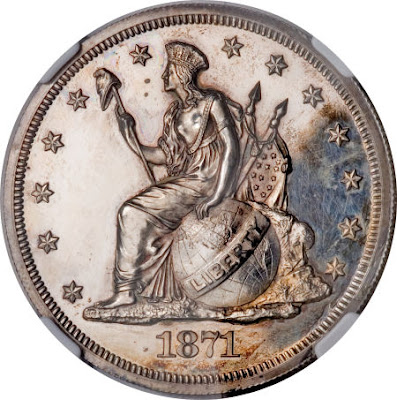
The May Long Beach auction has a pair of unexpected treats in the form of two old-time collections that have been off-the-market for half a century or more. The more prominent of these two collections is the Frank M. Stirling Collection, which contains a number of gorgeous patterns and other coins that come with envelopes from leading dealers of the 1950s. Names such as Hans M.F. Schulman, M.H. Bolender, and B. Max Mehl are all represented. Most interesting is the card accompanying lot 1428,an extremely rare Judd-1138A Indian Princess dollar struck in silver. The card notes that the pattern was previously in the Palace Collections and notes its sale to “F.M. Stirling,” with the signed attestation of Abe Kosoff.

Abe Kosoff was a titan among numismatists of his generation, not only one of the most knowledgeable and prominent dealers of the era but also held in high regard as a gentleman and friend; Q. David Bowers subtitled his biography of Kosoff “Dean of Numismatics,” a title with just the right connotation by virtually all accounts. He died in 1983, before I was born, so I never had the opportunity to meet him, but he left a remarkable body of written work in the form of a series of articles. These articles, published over a 13-year span in Coin World, were collected in the volume Abe Kosoff Remembers… and organized by topic.

One topic, which dominated Kosoff’s column for three months in late 1977 and the start of 1978, is the auction of the Palace Collections of Egypt in 1954. These collections, assembled by King Farouk of Egypt at great cost to the national coffers and confiscated after Farouk was driven out of the country by a military revolt, included coins, stamps, artworks, and antiquities. The coin auction was cataloged by Baldwin of London on-site in Cairo, and the polyglot auctioneer who called the lots was from Sotheby’s. Kosoff reported that his firm, which had sold many coins to King Farouk, made offers to auction the collection and to assist with cataloging, but neither offer met with a favorable reply.

Despite the astonishing accumulation of rarities in the Palace Collections, the prices realized were far less than they could have been. The auction cataloger was not familiar with American coinage, and so fabulous rarities were packaged into large lots alongside more common pieces. The short, vague descriptions scattered throughout the catalog also reflect the writer’s lack of understanding and the enormity of the task that was compressed into mere months.

The auction was a floor-auction only, held in a country far from the United States that was not at all removed from civil unrest; the house arrest and subsequent release of President Naguib took place during the coin auction itself. As a result, many collectors and dealers stayed away, but those bold enough to attend and bid strongly were rewarded many times over. Kosoff himself reported that he bought back many pieces that he had sold to Farouk for a small fraction of their original price, and his firm made money both ways.

Though it is unknown if Farouk purchased the Judd-1138A pattern from Kosoff in the first place, the envelope and card tell their own story of peril, profit, and the stranger-than-fiction relationship between a coin dealer and his royal client.

Click on the title of this post to leave a comment.

-John Dale Beety

Wednesday, May 13, 2009

Today’s the day for ‘Dr. Peppers Pepsin Bitters’. Are you ready?

May 13, 2009
Posted by Noah

I know I’m in trouble when I wake up in the middle of the night thinking about a particular lot or press release – or blog posting – that is coming up, and that’s exactly what happened to me last night. I didn’t exactly bolt upright in bed with a gasp, but I certainly woke up with an overactive brain and a terrible urge to scratch my legs and upper body where I was savaged by chiggers last Sunday during a Mother’s Day picnic at a nature preserve in North Dallas. I took care of the itch with Calamine Lotion, and turned my thoughts to today’s auctioning of The Old Corner Drug Store Ledger Book – i.e., the “Dr. Peppers Pepsin Bitters” recipe that caused such a stir last week – for a little midnight distraction from sleep. I mean, really, who needs to sleep anyway?

I haven’t checked in a few days, but the Dr Pepper story that Jamie Stengle of the AP broke early last week, as of Monday, was online in more than 800 worldwide outlets. This is an impressive head of steam for any story to have, let alone one as innocent as this little recipe. I’m going to be waiting around the Heritage HQ tonight for the piece to come up for bid – somewhere in the 4:00 p.m. hour – to see if all the PR, the outreach, and the tireless interviewing that the consignor, Bill Waters, did will pay off in the fashion that we believe it should.

This has been interesting to watch and be a part of from the inside because it was unexpected. A few months ago, when we first began discussing the PR on the lot, nobody thought it would make much difference outside of Texas, the birthplace of the famous soft drink. We all know now how wrong our assessment was. People all over the world are still big fans of the drink, and collectors of its related memorabilia, and any chance to glean even an inkling of what gives any famous soft drink its flavor is something that, I now understand, is sure to pique the interest of just about anybody.

For its part, the Dr Pepper Snapple Group – located about 45 minutes north of Heritage via the Dallas North Tollway – is about as sanguine as you might expect a major corporation to be when one of its namesake brands is put in this position. They never once denied the book’s authenticity, but they felt compelled to refute its being the absolute origin of Dr Pepper. The group made its point well enough, but facts is facts: There is no earlier use of the name Dr Pepper known, and certainly not one that can be tied so closely to the year of Dr Pepper’s patent (1885) and definitively to Waco, TX.

The question now is, do collectors feel the same? Has Dr Pepper’s careful denial had its intended impact? Will bidders go crazy over the opportunity? Will anyone actually be able to find Wahoo Bark and Mandrake root and whip up a batch of this stuff? Between us chickens, I reckon it would taste pretty rank.

The taste of Dr Pepper is the taste of my grade school football games, of rainy Saturday nights watching the Dallas Tornadoes soccer team getting beat by Pele’ and the New York Cosmos, and of the bottling plant tours my school classes used to get once a year when the plant was just down Central Expressway from here at Mockingbird Lane and Greenville Avenue. No matter what the recipe for ‘Dr. Peppers Pepsin Bitters’ sells for today, nothing can ever buy my memories – and the memories of millions of others – of the soft drink, and I can also guarantee that almost no one would be willing to try the recipe in the ledger book were someone actually able to mix it up.

Here’s a link to the lot. Let the games begin!

Click on the title of this post to leave a comment.

-Noah Fleisher

Tuesday, May 12, 2009

R. Crumb grouping readies for May 21 Comics Auction: Only the adventurous need apply


May 12, 2009
Posted by Noah

There are few American illustrators as iconoclastic as R. Crumb. His characters are alternately loathsome and endearing, and Crumb himself never met a boundary he didn’t want to cross. If you know his work, then you know what I mean. If you’ve never seen any of his comics, or had the guilty pleasure of reading them, then I suggest you do a gut check before picking up an issue or compilation. If you are easily offended, then don’t even start.

The Comics auction at Heritage on May 21 is already filled with truly spectacular stuff – see The Chicorel Collection, Showcase #4 from the Motor City Run, or a Gem 10.0 Mint Wolverine #1 – but, as with so many of the cool auctions here, there are jewels sprinkled throughout the auction, not the least of which is a small grouping of lots from the pen, pencil, markers and crayons of dear Mr. Crumb, always a popular subject when he turns up in Heritage Auctions. They are all great examples of his inimitable style, though only one – a complete eight-page story from Hup!, which depicts Crumb as a full grown man, slobbering and shaking, dressed as a baby, being pushed around in an oversize pram by a buxom nursemaid, who is of course the object of his obsession – is truly salacious in the disturbing manner that only Crumb could embody.

Two of the lots feature, separately, the master’s two most famous characters: An early transitional period cover drawing for a never-realized comic called Inkling, featuring none other than Mr. Natural, and a very rare latter period drawing of Fritz The Cat for a 1993 for a collection of Fritz stories.

The Fritz drawing is one of the last times that Crumb drew Fritz, minus another notable 1996 drawing, and is a pretty classic representation of the haggard feline hounding one of his lady friends for a little “attention.” If you know anything about 1970s illustration and – in particular – animation, then Fritz The Cat is immediately recognizable as much for the comic books as for the Ralph Bakshi cartoon movie of the character, and for the massive firestorm of controversy that surrounded it. FYI, Bakshi was and is one of the greatest animators of the 20th century for a variety of reasons too numerous to mention here. Just watch the cartoon and you’ll see what I mean. There was so much attention paid to the movie and the comics, and Crumb was so pursued by the press that he actually killed the character in the pages of The People’s Comics in 1972.

You can check out the grouping here. In the realm of high-priced material, these are pretty affordable, ranging between about $1,000 to more than $5,000. Who knows what they will really bring, as the collectors dedicated to crumb – and in particular to Mr. Natural and Fritz The Cat – are indeed very serious in their pursuit.

When I was a boy in the mid-1970s, Bakshi’s Fritz The Cat was still quite a controversial cartoon. I remember it playing late one night on Dallas’s first pay-per-view station, Vue – a precursor to cable and DTV and all of that, you know you remember it – and my brother Matt told me he was going to watch it, as he somehow knew something about it already.

It turns out that he chickened out, or fell asleep, and I was left to my own devices. Sometime around midnight I crept into the TV room, closed the door, flipped that sucker on and turned down the sound. Needless to say it was quite and eye-opener, and an eyeful, for an eight-year-old, but I could still see the inherent humor in the story and the quality in the characters and animation. It led me to a full-blown Bakshi obsession in later years, where I watched movies like Wizards, Hey Good Lookin’!, American Pop, Heavy Traffic, Street Fight and – many times again – Fritz The Cat. If you are a discriminating fan of truly cool underground animation, then I heartily recommend Bakshi’s movies.

Here’s another look at the Crumb grouping if you’re curious.

Click on the title of this post to leave a comment.

-Noah Fleisher

Monday, May 11, 2009

Where the Dollar Began

May 11, 2009
Posted by John Dale

According to Wikipedia, today it is a small settlement in the Czech Republic, population around 3,500 residents as of 2006. From the early 1500s through the late 19th century, however, the town named for Bohemia’s St. Joachim’s Valley, or Joachimsthal in German, was a center of silver mining and minting for Europe. As recounted in various sources, including the Guide Book of United States Coins (also known as the Red Book and a U.S. coin collector essential), the term for the large silver coins struck at the mint in Joachimsthal was Joachimsthaler, a name later shortened to thaler as use of the term spread beyond Bohemia.

A derivative of thaler is the word “dollar,” and the Spanish dollars (known more popularly as pieces-of-eight) that made up much of the circulating coinage of the American colonies directly influenced the choice of the word “dollar,” both for Revolution-era money such as the Continental currency and the federal coinage as authorized in 1792. It was not until two years later, however, that the dollar as a denomination would be struck in silver. Just 2,000 pieces were struck on a single pair of dies, with all bullion supplied by the Mint Director, David Rittenhouse, and after the culling of specimens deemed unacceptable, the remaining coins – all 1,758 of them – were paid back to Mr. Rittenhouse.

Since coinage did not resume until the next year, those 1,758 coins were the only 1794 silver dollars produced, and the vast majority of those have been lost to time. Today, the 1794 dollar is very scarce in any grade, with even generous estimates of the number of survivors topping out at 10% of the mintage. As a result, the opportunity to examine (or better yet, purchase) a 1794 dollar, such as the one coming up in the May Long Beach auction, should not be missed.

As expected for a coin that is more than two centuries old, this 1794 dollar is not absolutely pristine; it shows light to moderate wear across the flowing-hair portrait of Liberty and the thin eagle within its wreath (though the apparent loss of detail around the rims comes from striking problems and not circulation). In addition, NCS notes a repair on the coin, though said repair is skillfully done and well-hidden. Neither the wear nor the repair affects this memorable coin’s historic aura, its enduring connection to the early days of U.S. coinage. After the bidding has ended, perhaps this 1794 dollar’s new owner will sit with the coin, examine it, and let it take him or her back to where the dollar began.

Click on the title of this post to leave a comment.

-John Dale Beety

Friday, May 8, 2009

Coin Friday: Silver Spoon, Gold Dollar

May 8, 2009
Posted by John Dale

(No worries, Coin Monday will still be where it's supposed to be, right on schedule. Today, though, it’s a Friday, it’s hot and muggy in Dallas, and our own John Dale Beety has consented to give your humble host blogger a day off from the blog. It gives me a break and you an extra taste of his skill as a writer and his knowledge of numismatics. John Dale’s coin posts have been very popular on this blog so I am happy to give our readers a little bit extra John Dale this week and thankful to him for letting me jump his post ahead in the queue. Enjoy, and have a good weekend. – Noah)

I was sitting at my keyboard, clicking away, when I heard a small sound to my left.

I turned my head and glanced at my box of coins. The stem of a spoon was sticking up from it. I was instantly suspicious. I knew there had not been a spoon in my box before, and unless my job duties had changed since that morning, I didn’t belong to the Silver and Vertu department! Then I noticed my manager nearby.

“Hey, wait a minute!”

“No takebacks!”

There was little I could do but pick up the spoon and take a look. To my surprise, it was well within the realm of U.S. coins: a commemorative spoon from the Louisiana Purchase Exposition with a 1903 Jefferson gold dollar mounted in the bowl.

The Louisiana Purchase Exposition, more popularly known as the St. Louis World’s Fair, honored the centennial of the Purchase, which added vast amounts of territory to the fledgling United States, including the land on which the fair was held. A slight delay in the celebration, from 1903 (the actual centennial year) to 1904, allowed for a wider range of states and nations to send exhibits. Offered to fairgoers were thousands of different souvenirs, including commemorative coins. The World’s Columbian Exposition, held in Chicago in 1892 and 1893, had established a precedent for silver commemoratives, and with the influence of Farran Zerbe, a noted dealer-promoter of the time, the Louisiana Purchase Exposition marked the nation’s first gold coinage with commemorative designs.

The gold dollar denomination, not struck since 1889, was resurrected for the Exposition’s commemorative coinage. All pieces shared the same reverse, but there were two obverse portraits created: one for Thomas Jefferson, the president who agreed to the Louisiana Purchase, and William McKinley, who would have been president at the time of the Exposition had he not been assassinated. As has often been the case with American commemoratives, hopes for sales far exceeded reality; few people were willing to trade three paper dollars for a single gold one, and a majority of the pieces struck went unsold and were melted.

The commemorative gold dollars were sold on their own, but also mounted in a variety of objects; most often noted are jewelry – such as stickpins and brooches – and commemorative spoons. This spoon has the gold dollar (with Jefferson portrait) mounted in the middle-lower part of the bowl, below a domed building and surrounded by sculpted walkways and water; a caption above describes the area as the “Festival Hall and Cascades.”

On the stem, figures appear on a leftward march toward the bowl, starting with two bison and progressing through horses-and-riders, a covered wagon, and a locomotive; these figures are flanked by commemorative dates, 1803 to the left of the bison and 1903 to the right of the locomotive. The back of the stem shows a notation for silver and text that describes the spoon as an official souvenir of the Exposition. The back of the bowl is engraved “Martin,” but with no surname.

The gold dollar, though lightly worn with minor scratches and hairlines that might indicate a past cleaning, has a pleasing look that suits the spoon well. Exposition souvenirs with their gold dollars inside are elusive and draw plenty of attention when they appear at auction. Look for this spoon, as well as a whole host of other fascinating items, in our online catalog for the Long Beach auction, up now!

Click on the title of this post to leave a comment.

-John Dale Beety

Thursday, May 7, 2009

What’s so great about Lincoln? I’ll tell you what’s so great about Lincoln!

May 7, 2009
Posted by Noah

First of all, that awesome beard. Second of all, that awesome stove pipe hat. Third, The Emancipation Proclamation. Fourth, the fortitude and foresight to see – and say – that a house divided against itself cannot stand. Fifth, the fact that almost 145 years after his assassination on April 14, 2009 – that’s Ruination Day, if you know your obscure references – he is far and away the most beloved American president.

He also had very neat handwriting.

How do I know? It just so happens that I’ve been doing a little more of that thing I so love to do in this job, which is to write about the crazy, cool and utterly historic pieces of material culture that make their way through Heritage every day. I hope that I am never cynical enough to be jaded about the awesome things I am privileged to see, because that would be a sad sad day. I have spent much of the last two days thinking and writing about a single page of longhand text, 23 lines in all, written by Abraham Lincoln himself for his 1864 State of the Union message. It was written just after he had won re-election in a difficult campaign, was on his way toward a resolute victory in the Civil War and was just five months shy of that fateful night at Ford’s Theater. It’s a crazy thing, really, if you think about it too much.

It is, btw, part of our June 16-17 Historical Manuscripts auction, if I may plug the company a bit.

This particular stretch of text finds Lincoln hardened and unyielding. He would settle for no less than total surrender from the Rebels, and complete preservation of the nation. He writes:

“... We are not exhausted, nor in process of exhaustion… We are gaining strength, and may, if need be, maintain the contest indefinitely.”

In other words, the jig is up. The Civil War was hugely bloody, fraught with a million and one tragedies and is still the war that inspires the most in American imaginations. The Revolutionary War may have provided us with a mythos and a pantheon of heroes, but The War Between The States provided us with our seasoning and character. No form or manner of wartime memorabilia is more visceral and tangible than Civil War relics, and no wartime memorabilia can give you the feeling of battle better than Civil war artifacts. It’s the truth. As Scatman Cruthers said in The Shining, this stuff simply shines, and nothing more so than those things directly linked to the man who bore the greatest burden, and the judgment of history, Abraham Lincoln.

Yes, this is an exciting, well-documented lot, and it will bring a pretty penny from a very erudite collector, likely upwards of $100,000+.

The kicker with this thing, actually, is that it was – literally – plucked from the dustbin of history by Superintendent of Public Printing in 1864, J. D. Defrees, who would have been given the original handwritten manuscript to typeset, make copies and distribute. Nothing was ever thought of handwritten copies, except on the day this one went to print. Defrees reckoned the pages would make neat gifts for some friends. He gave them out and hence to posterity. Only 11 very well documented fragments exist to this day, and this is one of them.

It’s a very cool, and very humbling, thing. Here’s another look if you haven’t yet clicked.

Click on the title of this post to leave a comment.

-Noah Fleisher

Wednesday, May 6, 2009

Tell me your story and I’ll tell you mine: Introducing Heritage Collector’s Corner

May 6, 2009
Posted by Noah

It finally feels as if we can surface for a breath around here. As Jim noted yesterday, when it rains it pours and Heritage has seen its share of the rising tide in the last few days. Super rare coins, a controversial early formula for a tonic that bears the name Dr Pepper, and way more than I can write here and now about what’s coming up. It’s a whirlwind most days on the Good Ship Heritage, and I wouldn’t want to have it any other way. It’s hard work, but mighty good if you can get it.

Rather than take today’s blog post – and the coveted half hour I have to write it – and talk about any of the myriad amazing things currently readying for auction, or having just been there, I wanted to talk about a way in which we’ve all agreed upon here to get some of the great stories and brilliant minds of our collectors out to the general public. It’s a little experiment that we’re calling the Heritage Collector’s Corner, and we want you in it!

The basic ground rules are as follows:

Heritage Collector’s Corner: Why, and what, do you collect?

We’re well aware here at Heritage that our clientele are some of the most interesting, influential people around, and all of you come with a story. Now we want you to tell us just what that story is. Maybe it’s a remembrance of why you started collecting, or a survey of how far your collection has come. We’re looking for stories that can wow, make us laugh or cry, or otherwise remind us why we collect what we do. We would like to share these stories with the rest of the Heritage community, so this is an open call and a chance for you to tell your story.

Submission Guidelines:

1. Send submissions to CollectorsCorner@HA.com (You can also send ideas for other topics.)

2. Submissions should be less than 2,000 words

3. Select submissions will be published anonymously by Heritage on the Heritage Blog, in company e-mails and in web promotion. All submissions are subject to editing and proofing. The author’s name will remain confidential.

How does this strike you? I’ll share a bit myself in the hopes of getting this thing started:

My own roots as a collector of sorts goes back to my childhood. My folks were ardent antiquers, yes, but I was bit by the collecting bug very early on myself, when I used to make the long drive from Dallas down to Round Top for the annual antiques fair there as a kid. My mom would give me and my brothers each $10 or so - $20 in the good years before the early 1980s recession here in Texas – and bid us do our own things for the next five or six hours.

I know it sounds anathema to today’s prevailing childcare mores to let your kid just disappear in a vast crowd, hours from home, with no way to check in – simply, “be back here at 3 p.m.” – but that’s the way it was. I knew enough to take care of myself, could run fast and bite and kick if necessary, though no situation ever arose. And for me it was simply Nirvana. I had a clear stretch of hours and hours to wander about, talk to people, get a couple burgers in The Rifle Hall – I can still taste them now! – and, most important of all, a full day of complete freedom from my constantly bossy, poking and punching older brothers. It’s where I got my first taste of, and fondness for being a loner.

I have to laugh at that now, married and with a toddler as I am, and knowing that I am lucky if I get even five minutes in any given day that’s not dedicated to my family or work. In fact, those infrequent days are the stuff of great nostalgia to me, as are the trinkets that I would pick up with the few dollars I didn’t spend on hamburgers, cokes or candy bars. Usually it would be an old, rusty toy of indiscriminate age, or a tin star that may or may not have actually been used by a lawman – most likely not – but I treasured those things, showed them off at school and kept them hidden from my fast-fingered brothers for years and years until they ended up in the trash with so many other trinkets from my childhood.

No, I don’t have the time to do much collecting anymore, and I certainly don’t have the money to get the things I would really want, but the bug has stayed with me. It ultimately led me into the business of writing about antiques and art, then editing magazines about them, and finally to my current happy perch at Heritage. It’s funny how the little things add up in the end to a great big important whole I would never have seen coming. Yet here I am.

Send your stories to CollectorsCorner@HA.com.

Click on the title of this post to leave a comment.

- Noah Fleisher

Tuesday, May 5, 2009

Dr Pepper artifact is huge news story; Social media advances at Heritage

May 5, 2009
Posted by Jim Halperin

(There is little for me to say, today, other than thank you to Heritage’s co-founder Jim Halperin, who has lent his time and name to today’s post. He’s one of the more recognizable names in our business, and also a futurist of significant note – if you haven’t read his best-selling 1996 novel, The Truth Machine, it’s worth a go, especially of you like your fiction on the sci-fi/speculative side. You can buy it at Amazon.com or download it free at www.TruthMachine.com. With all the news of late about the Dr Pepper ledger going up for auction May 13 here, we all felt it was a perfect time for Jim to step in and address the blogging public. – Noah Fleisher)

What an exciting seven days here at Heritage!

We started last week with the sale of “The King of Coins,” a Class III 1804 $1 at our Central States Numismatic Society Platinum Night Auction, Thursday, April 30, for $2.3 million, garnering international media coverage. When a coin of this magnitude and fame comes to auction, the world takes notice. The auction itself netted approximately $45 million, a record for any numismatic auction other than a few Heritage FUN auctions, which occur every January in Florida and are invariably the largest numismatic auctions each year.

If that wasn’t enough, the Associated Press broke the story last weekend about the presence of a circa 1880-1890 ledger from The Old Corner Drug Store in Waco, TX, which we are auctioning off on May 13. This ledger contains what we believe to be the earliest known reference to the name Dr Pepper, and possibly an original formula of sorts for a tonic that may well have evolved in to the Dr Pepper we know and love today.

In the last two days, the story has taken on a life of its own. We’ve seen it in more than 400 worldwide media outlets, from New Zealand to India and the Philippines, and on NPR, BBC, on local news broadcasts across the region and on too many blogs to count. For several hours on Monday morning it was the most viewed and the most emailed story on the entire Internet, according to Yahoo! News. Just Google Heritage auction Dr Pepper formula, and you’ll see.

Now the Dr Pepper Company, which sent a delegation here last week to view the formula, has issued a non-denial denial about the formula in the book, stating simply that it’s not the formula that is used to make Dr Pepper (which we never said it was). Uh, no kidding. To their credit, however, they are not denying that it’s an original Dr Peppers Pepsin Bitters formula from the late 1800s.

My whole family and I LOVE Dr Pepper, by the way, as do practically all Texans – even transplants like us.

Greg Rohan, President of Heritage, has stated it best in our own clarification to the media, as follows:

“In its carefully worded statement, the Dr Pepper Snapple Group never claims that the ledger book from The Corner Drug Store in Waco, currently in our vault and preparing for auction on May 13, isn't the original formula, just that it's not the current one. We agree! We've always indicated that this document dates back to around 1880-1890, precisely the time when the first patent for Dr Pepper appeared.

“We know of no earlier reference to the name, and certainly not one that can be traced, conclusively, back to the drugstore where Dr Pepper was created. Like millions of others, we at Heritage Auction Galleries remain fans of the beverage and of the way its formula tastes today. We certainly wouldn’t recommend reverting to the original formula!”

Heritage operates from a place of transparency and honesty. The way we’re presenting this lot – and, happily, the way in which it is being portrayed across the planet – reflects that honesty, no matter how anyone else may try to spin it.

It is exciting when one of our upcoming auctions captures the world’s attention, as the Dr Pepper lot has done, but it’s a whole new ball game when a news story gets legs like this. This story has now survived several different news cycles – a feat in and of itself – and still seems to have steam.

Last but not least, throughout all of this, Heritage has been on top of the wave of social media. I’ve been Twittering about developments since the 1804 $1 sold last Thursday, and since the Dr Pepper story broke, and you can also find plenty of Heritage Auction stories if you dig into StumbleUpon, Reddit and Digg, all state-of-the art social media meant to keep people informed in this instant-fix 24/7 news environment. I’m proud to say that I know of no other auction house on earth that is, or ever has been, as technologically adept and current as Heritage. We owe our valued consignors and bidders nothing less.

Click on the title of this post to leave a comment.

Monday, May 4, 2009

It’s a cent! It’s a dime! It’s… an 11 cent piece?!

May 4, 2009
Posted by John Dale

Confusion is rare in the coin cataloging department at Heritage… after all, we are catalogers: We’re logical; we organize and write with clarity! Unfortunately, we do have one weak point: our names.

There are two Marks: Chief Cataloger Mark Van Winkle and Senior Cataloger Mark Borckardt. Of the rest of the cataloging staff three out of four are named John or Jon; only Brian Koller has a first name to himself. It’s impossible to say “Hey, Mark!” or “Hey, John!” without sending multiple heads swiveling. Our names also cause more than a few double-takes when Heritage tours come through.

“This is our cataloging department… and here are Jon Amato, John Salyer, and John Beety, our three Johns.”

Naturally, we’ve come up with our own nicknames, though I had to promise not to reveal any of theirs under pain of swift and terrible retribution. That side of the conversation looked something like this.

The catalogers’ nicknames may be off the table, but there’s another nickname I’m free to talk about: “11 cents.”

That nickname is given to a particular error coin, created when a previously minted dime is fed into a coinage press and receives a second strike, this time from cent dies, as happened to a coin in our upcoming Long Beach auction. It was struck twice in 2001 at Philadelphia. The “11 cents” nickname comes from the two denominations added up, “10 cents” for the dime with “1 cent” struck on top. Other varieties created the same way have similar nicknames; most commonly heard is the “6 cents,” in which a previously coined cent receives an impression from nickel dies.

Beyond their rarity (the multiple examples to be offered in our Long Beach auction are exceptional), errors like the “11 cents” are simply fascinating regardless of whether or not one is a coin collector. There is something wonderful yet disconcerting about seeing two faces on one coin, with Lincoln’s unmistakable yet strangely transformed image stamped over the ghostly effigy of Roosevelt. The reverse is less surreal and more whimsical, with unintended foliage growing around the Lincoln Memorial.

Speaking from personal experience, one of the greatest rewards of owning an error coin is being able to show it to others and watch their faces as they try to figure out what went wrong. There is endless variety in the wide-eyed stares and statements of incredulity!

Of course, aside from this auction’s bounty of error coins, there is a wide range of rarities struck as intended that shouldn’t be neglected! Take an hour or two to page through the catalog, whether online or on-lap, and enjoy our broad selection of numismatic treasures.

Click on the title of this post to leave a comment.

-John Dale

Friday, May 1, 2009

Adams-Carter 1804 $1 brings $2.3M, Halperin Twittters, and Platinum Night is a rousing success

May 1, 2009
Posted by Noah

$2.3M on a $1 coin? That’s like, what, a return of 2.3M%? Where can I get odds like that?

In all seriousness, it is after midnight as I write this and I just spent the night glued to my computer watching the “dramatic” unfolding of the CSNS Platinum Night Auction and the selling of the Adams Carter Class III 1804 $1, which did indeed bring $2.3. Either coin collecting has gotten amazingly cool – as in I’m such a cool guy – or I’ve lost all perspective on what coolness means. I guess I’d have to go with the latter, though I know all of you would heartily disagree and insist on the former…

It was indeed a good night, with the total topping $32M for the session and more than $35 for the overall event, and there are still more sessions coming. It’s looking good. If you didn’t follow Jim Halperin’s Twittering throughout the night you missed some good fun. He’s a natural for it, and he’s got the charisma to make it interesting in the voyeuristic way that makes Twitter such a guilty pleasure. Here’s a sample:

“Platinum Night just ended. Coin auction at $32,979,089 with 4 sessions to go, plus Currency, so we should break $40 million. Not too shabby.”

“John Albanese on his $2.3 million 1804 $1: 'I don't drink, I don't smoke, so I needed a coin fix, and this will satisfy me for a while.'”

Given that I can’t really speak with any authority on the real meaning of coins, I’m going to turn it over to John Dale, who relays a true inside understanding and excitement about the event:

“It's past midnight in Cincinnati and past 11 p.m. in Texas, but I might have trouble getting to sleep tonight. I just finished watching a bit of numismatic history.

“First things first: $2 million hammer price on the 1804 dollar, $2.3 million with buyer's premium. It's Heritage's fifth multi-million-dollar coin sold at auction, and though all the action was online, there was still plenty of excitement, a Digital Age version of the mail bidder against the floor bidder.

“A HERITAGE Live! participant, seeing a starting bid of $1.7 million established by an Internet bidder, put up a digital paddle twice, the second time a cut bid at $1.95 million. The Internet bidder was willing to bid $2 million, though, and the Heritage Live bidder didn't jump in for another full increment. The lot was hammered down, and the sale moved on, but not before some clapping.

“Walking into that room, then, there was an auction record set for a Class III 1804 dollar; the previous record, set back in 2003 by the same coin, was just more than $1.2 million including buyer's premium, so a minimum hammer price of $1.7 million was going to blow that figure out of the water.

“(Auctioneer) Bob Merrill also moved even higher on my Cool People list when he paused the action just before the 1804 dollar.

Mark Borckardt, the "missing name" in my earlier post about the 1804 dollar, is the Senior Cataloger at Heritage, someone who's up there on the aforementioned Cool People list, and was in attendance. Bob took time to point him out and start a round of applause, praising Mark as the best in the business. I sat at home, watching and listening, and I smiled a little. Two more decades in the business, and maybe I'll get where he is... maybe. Beyond the obvious, the expertise that comes from being a professional numismatist for more than half one's life, Mark has a level of innate numismatic talent that leaves me in awe. Oh, yes, and he's a better bowler than I'll ever be.

“Back to the auction proper. As impressive as the 1804 dollar's showing was, the Platinum Night offering was more than just the 1804 dollar and a bunch of backup singers. Platinum Night hauled in more than $27.4 million, meaning that even if one were to take away the 1804 dollar, it would still be a $25 million session. There's plenty of money out there to buy the best coins, and many bidders took opportunities when they saw them. Of course, the auction is far from over, and judging from the bidding on a few of the lots yet to come, it seems as if they would've been right at home in Platinum Night. It'll be interesting to see how it all shakes out...and how the news wires respond.”

Thanks John Dale! FYI, AP has already picked up the story, it has appeared in Texas, Ohio and New Jersey, so it should break nationally today, if it hasn’t already by the time this gets posted.

Click on the title of the this post to leave a comment.

-Noah Fleisher and John Dale Beety